 SKU 2129
Sensors & Modules
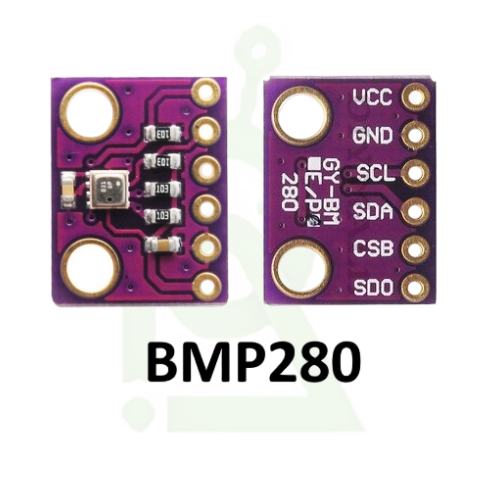
BMP280 Temperature and Pressure Sensor – Digital Barometric Sensor Module
₹100
01 — About
What it does
The BMP280 Temperature and Pressure Sensor is a high-precision, ultra-low-power digital barometric pressure and temperature sensor module designed for weather monitoring, altitude estimation, indoor navigation, and IoT applications. Developed by Bosch Sensortec, this compact sensor delivers ±1 hPa absolute pressure accuracy and ±1.0°C temperature accuracy with a tiny LGA-8 footprint. Featuring both I2C and SPI interfaces, three programmable power modes, and a built-in IIR filter, it is the ideal choice for Arduino, Raspberry Pi, ESP32, and other embedded platforms requiring reliable environmental sensing in space-constrained designs.
Key features
- High-precision barometric pressure measurement: 300–1100 hPa
- Temperature measurement with ±1.0°C accuracy
- Absolute pressure accuracy: ±1 hPa (typical)
- Relative accuracy: ±0.12 hPa (equivalent to ±1m altitude)
- Ultra-low power consumption: 2.7µA @ 1 Hz sampling rate
- Ultra-low sleep mode current: 0.1µA
- Dual digital interfaces: I2C (up to 3.4 MHz) and SPI (up to 10 MHz)
- Two selectable I2C addresses: 0x76 and 0x77
- Built-in IIR filter for noise reduction
- Three power modes: Sleep, Forced, and Normal
- Factory-calibrated with compensation coefficients in OTP memory
- Compact LGA-8 package: 2.0 × 2.5 × 0.95 mm
- Wide operating temperature range: -40℃ to +85℃
- 3.3V and 5V logic compatible (module versions)
Good to know
- Do not connect the bare BMP280 chip directly to 5V logic — the chip operates at 1.71V–3.6V. Use a 3.3V regulator or a 5V-compatible breakout module with onboard level shifting.
- When using I2C, connect CSB to VCC (or leave floating on modules with pull-up) to select I2C mode. Ground CSB to select SPI mode.
- Set the I2C address by controlling the SDO pin: connect to GND for 0x76 (default on most modules) or to VCC for 0x77.
- The sensor is factory-calibrated — no external calibration is required. Compensation coefficients are stored in internal OTP memory.
- For outdoor use, enclose the sensor in a radiation shield or ventilated housing to protect from direct water ingress and direct sunlight.
- Mount the sensor on vibration-dampening material when used in drones to reduce noise from motor vibrations.
- Use the Bosch Sensortec API or official libraries for optimal readout and compensation calculations.
- Store in anti-static packaging when not in use to prevent ESD damage.
02 — Datasheet
Specifications
- Chip Model
- BMP280 (Bosch Sensortec)
- Sensor Type
- Digital Barometric Pressure + Temperature
- Pressure Measurement Range
- 300 hPa – 1100 hPa (+9000m to -500m above sea level)
- Pressure Absolute Accuracy
- ±1.0 hPa (950–1050 hPa, 0℃ to +65℃)
- Pressure Relative Accuracy
- ±0.12 hPa (700–900 hPa @ 25℃), equivalent to ±1m
- Temperature Measurement Range
- -40℃ to +85℃
- Temperature Accuracy
- ±1.0℃ (at 25℃), ±0.5℃ typical
- Temperature Resolution
- 0.01℃ (in full oversampling mode)
- Pressure Resolution
- 0.16 hPa (ultra high resolution mode)
- Operating Voltage (VDD)
- 1.71V – 3.6V (chip); 3.3V/5V (module)
- Interface Voltage (VDDIO)
- 1.2V – 3.6V
- Interface
- I2C (up to 3.4 MHz) / SPI (3-wire and 4-wire, up to 10 MHz)
- I2C Address
- 0x76 (SDO low) / 0x77 (SDO high)
- Current Consumption (Normal Mode)
- 2.7µA @ 1 Hz (typical), up to 4.2µA max
- Current Consumption (Sleep Mode)
- 0.1µA (typical), up to 0.3µA max
- Peak Current (Pressure Measurement)
- 720µA typical, 1120µA max
- Measurement Time
- 5.5 ms (ultra-low power preset)
- Maximum Sampling Rate
- 157 Hz (forced mode)
- IIR Filter Options
- OFF, 2x, 4x, 8x, 16x
- Oversampling Options
- 1x, 2x, 4x, 8x, 16x (independent for pressure and temperature)
- Package Type
- 8-pin LGA with metal lid
- Chip Dimensions
- 2.0mm × 2.5mm × 0.95mm
- Module Dimensions (typical)
- ~11.5mm × 15mm (varies by breakout board)
- Pin Pitch
- 2.54mm (module)
- RoHS Compliance
- Yes (Lead-free, halogen-free)
- Application Type
- Arduino, Raspberry Pi, ESP32, weather stations, drones, IoT